
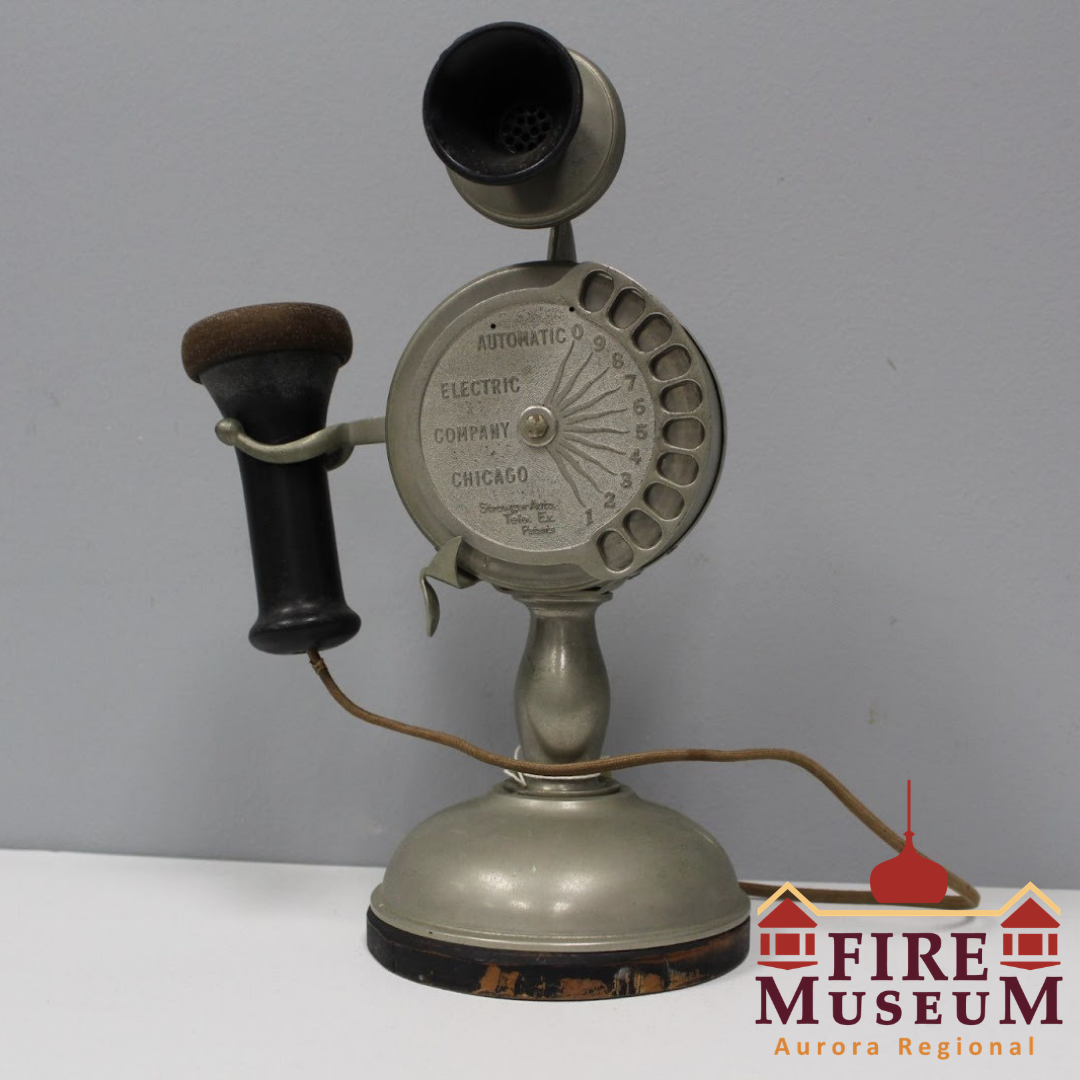
This artifact is a Strowger Potbelly Candlestick telephone, the first commercially available dial telephone. This particular example of Strowger's eleven-digit dial phone, dating back to 1905, revolutionized telecommunications. It did this by bypassing the need for telephone operators and allowing users to directly dial one another’s phone numbers. The speed of the rotary dial allowed for fast contact with fire and police services rather than utilizing the limited number of specialized fire alarm call boxes. Through a combination of innovative spirit and his conspiratorial resentment for switchboard operators Almon Strowger (1839-1902), an American inventor, developed the Strowger switch, a technology to bypass phone operators. Strowger was working as a funeral director, responsible for managing the funeral processes for the community of Kansas City, Missouri. Strowger had constant issues with his telephone. In addition to functionality problems, he believed that the local women working as switchboard operators were purposely misdirecting calls, sending them to his business competitors and causing him to lose a great deal of business. Strowger would often fly into long-winded rants about the switchboard operators, and would constantly call the phone company for repairs.
A 1913 article from the Sioux City Journal interviewed Mr. Herman W. Ritterhoff, the superintendent of the Home Telephone company, and brief business associate of Stroweger. He was responsible for addressing Mr. Strowger's telephone complaints, frequently sending repair workers to his home. However, they never could find anything wrong with Mr. Strowger's phone, much to his fury. Mr. Herman Ritterhoff wrote about Strowger's switchboard obsession, saying, “he became possessed with the idea that the girl operators were systematically working against him, and that he was so convinced of this that he got to hate them. And his next idea was one of revenge against them”. Strowger's revenge, as it turned out, would come in the form of the Strowger Switch system.
Strowger revealed his new innovation to Mr. Ritterhoff in 1888. Upon seeing Strowger's technical drawings, Ritterhoff realized that despite their amateur appearance, Strowger had outlined a transformative technology that could revolutionize communication and make both men very wealthy. Strowger had developed the technical specifications needed to make a working telephone that had no need for central switchboard call management. The Strowger Automatic Telephone Exchange Company was founded in 1891 by Strowger with his brother Alfred and nephew William. Ritterhoff assisted him to refine his plans and apply for a patent in 1891 due to Strowger's crude artistic abilities which were of no humor to Strowger, who was known to be quick to anger and held grudges for life. Ritterhoff would later recount that Strowger's poor art skills and temper were responsible for Ritterhoff missing the chance of a lifetime after laughing at a crude prototype Strowger had built himself. Strowger stormed off in a rage and raised $50,000 in capital to start the Automatic Electric Company without Mr. Ritterhoff as a business partner. By 1892, the first phones utilizing the Stroweger switch were installed in La Porte, Indiana, by Stroweger for his personal use in his business. By the early 1910s, Stroweger switch phone systems made up 10% of all telephones in use, and were quickly becoming the standard automatic phone system in many cities. The system would also rapidly be adopted by fire and emergency services in the United States. Internationally, the British Post Office adopted the Stroweger system in 1912, with widespread adoption in wealthy metropolitan areas worldwide by the 1920s.
Ritterhoff eventually found out the real cause of Mr. Strowger's phone troubles. Strowger had decided to bring his rusting old shop sign inside and had hung it on the wall over his telephone. Every time his front door opened and shut, wind would rush in, swinging the old sign back and forth. And on occasion, it would be caught perfectly in the two wall posts that rose above the telephone causing a short circuit. This meant that whenever the repairmen came to fix his phone, by simply opening the door, they fixed the problem. While Mr. Ritterhoff surely found this explanation entertaining, it did nothing to sway Strowger's insistence that it was the fault of the switchboard operators.
Mr. Stowger continued his personal war against the switchboard operators, seeking to “put every last one of them out of a job”. Strowger Automatic Telephone Company had become Automatic Electric Company in 1901. By this point, Strowger had little involvement in the company, having sold his patent in 1896 and his shares in Automatic Electric in 1898. His patent sold for $1,800 (roughly $70,000 in 2026), and his shares sold for $10,000 (roughly $390,000 in 2026). Ritterhoff would later recount that Strowger's poor art skills and temper were responsible for Ritterhoff missing the chance of a lifetime after laughing at a crude prototype Strowger had built himself.
Ritterhoff had been promised 10,000 shares in the Automatic Electric Company, which by 1913 would have been worth millions. But upon traveling to Chicago to claim them, he learned Strowger had died and purposely left him out of his company. Prior to his death, Strowger would refuse to contact Ritterhoff for the rest of his life, even refusing to answer any letters sent by Ritterhoff. The Automatic Electric Company became greatly successful, financially dominating the telecommunication market into the 1940s, leaving Ritterhoff to comment in 1913: “That laugh cost me a million dollars”.
By Wyatt Harvell Aurora University Student