From the Collection

From the Collection-Telegraph

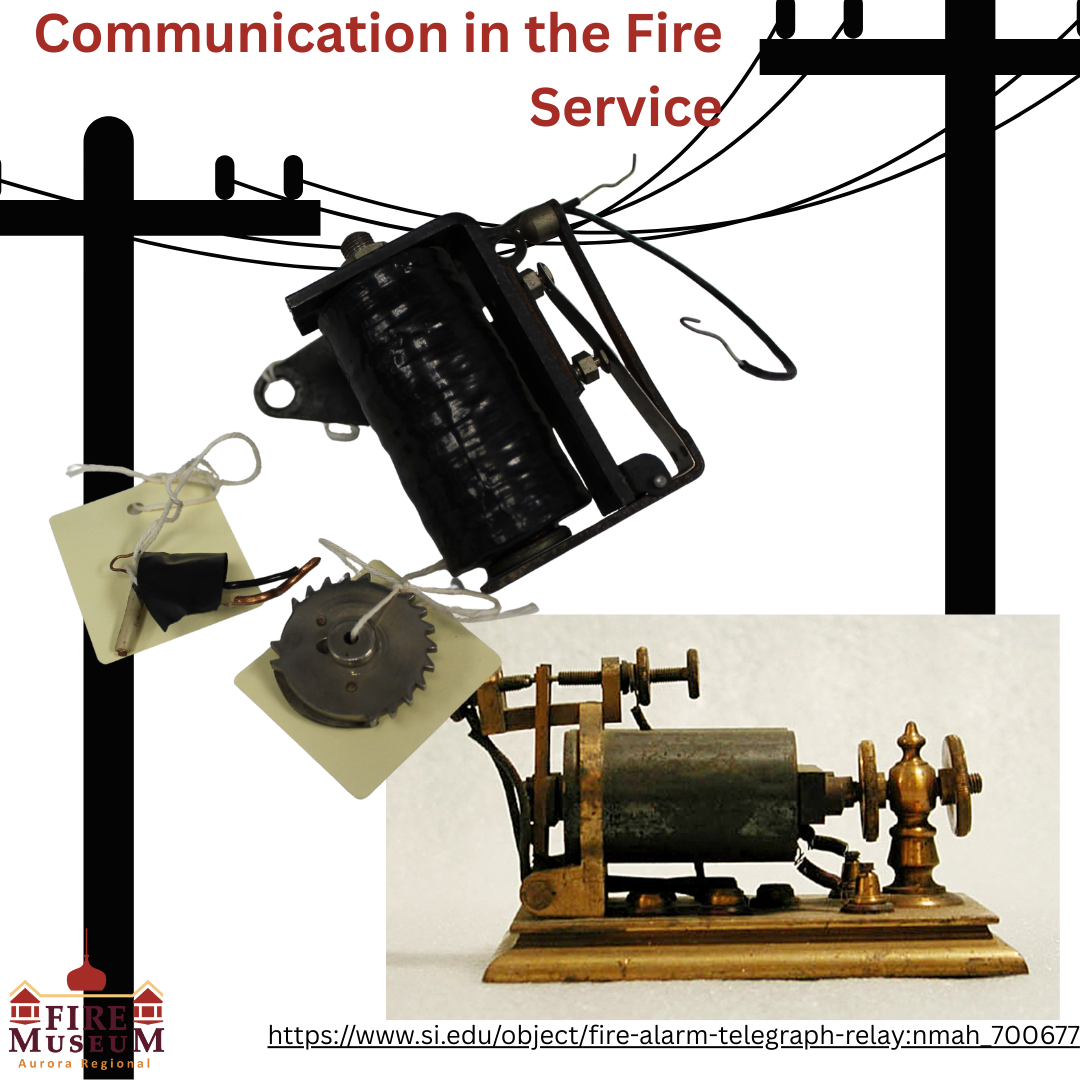
The bits of metal seen before you is actually a telegraph, though it may not seem like much but it was certainly helpful during the 19th century. The first aspect of the telegraph was made by a Frenchman called Claude Chappe. In the year of 1794, he was able to successfully create an optical telegraph that relayed a message over 9 miles. Europeans continued to advance this new technology until it reached the United States. The optical telegraph then began to lose its popularity when electrical telegraph began to be widely used. The difference between the two is that an optical uses towers with arms or boards on top to create words visually by moving the arms to communicate with the other towers while an electric uses a magnetic field to make the needle move left or right. Which was a much cheaper and stable option at the time. 

An American painter and inventor known as Samuel F.B. Morse began to fiddle around with the telegraph to relay messages for farther distances. He was then able to create a device that would be able to make a series of electrical pulses which would then be translated into words by the person receiving the message. Once this method was implemented by the government, states were now able to communicate with one another faster than ever before. The telegraph was then placed at official government buildings such as newspaper offices, police stations, and fire stations. The fire stations placed numerical alarm boxes with telegraph keys connected via a telegraph cable; One box is kept in the central alarm station, and the others are placed somewhere easily accessible out in the neighborhood. 

Reporting an emergency with the fire alarm telegraph was a multi-step process. First, the central alarm office receives the call from the fire alarm box from which it is pulled. The alarm office would know where the call was coming from based on the number of the fire alarm box that would be punched out of the piece of paper tape. Then, the dispatcher would send out the alarm and box number to the closest firehouse. Eventually, technology advanced and the telegraph became less popular once the telephone was introduced in the late 1800’s. 

In Aurora, the city finally authorized the construction of the fire alarm telegraph on December 18, 1878. By January 22, 1879 the connections of the fire alarm box were completed. One was located in the Broadway stairway of the Aurora National Bank block, and the other on River street. Unfortunately, in between the construction of the fire alarm boxes, a man by the name of Thomas Bexon fell to his death on the 15th of January in 1879 when he was fastening wire to the last pole.

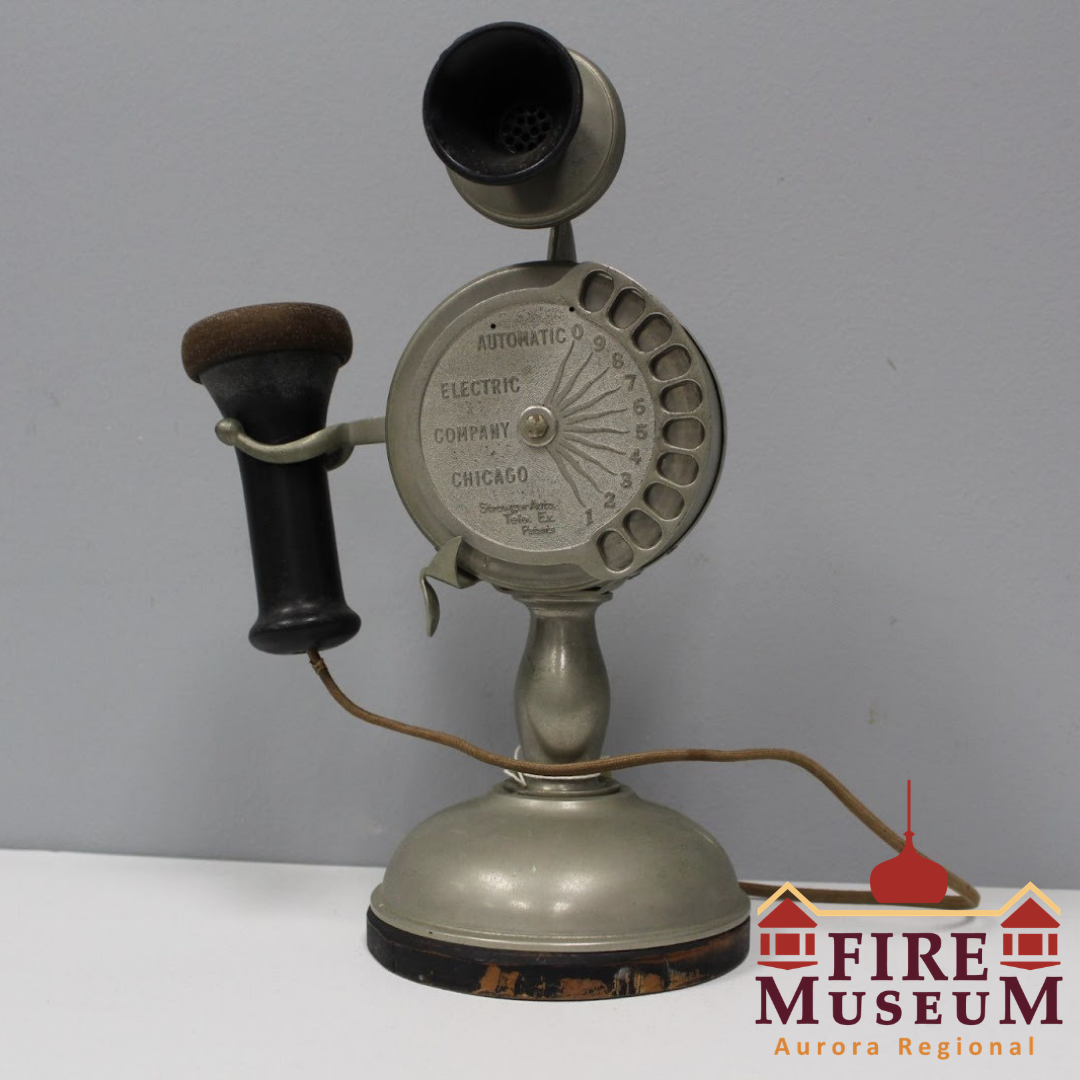
By the 1920's the rotary dial telephone became the most efficient way to communicate especially in times of urgency. This eventually led to the fall of the telegraph. The last telegram message was sent in the year of 2006 on January 26th to the office of Tom Wolfe in Manhattan.

By Paola Hurtado, Waubonsee Community College Student

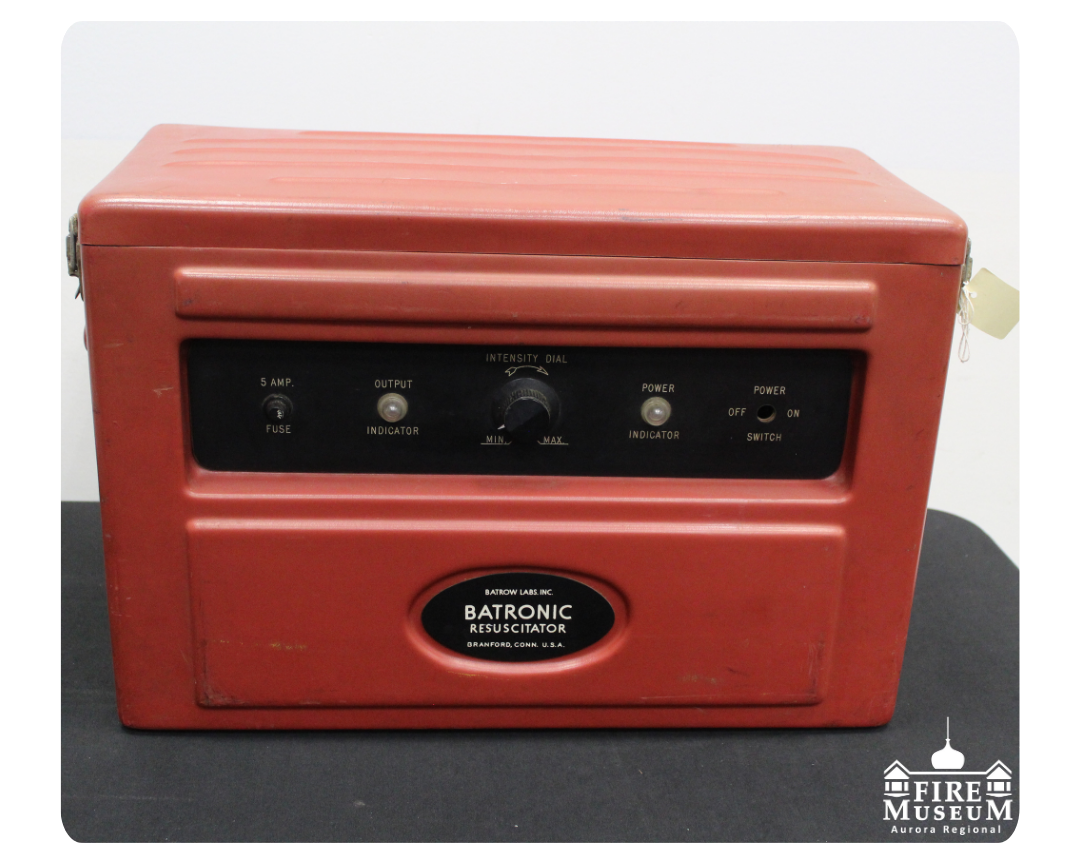
From the Collection-Batronic Resuscitator by Batrow Labs Inc.

A resuscitator is a device that inflates air into a patient's lungs to assist with breathing. Firefighters usually use resuscitators if a victim has inhaled smoke from a fire and needs their lungs restored with air. Firefighters and EMT's must be properly trained to use a resuscitator because using it incorrectly can injure the patient. The first resuscitator was created in 1907.

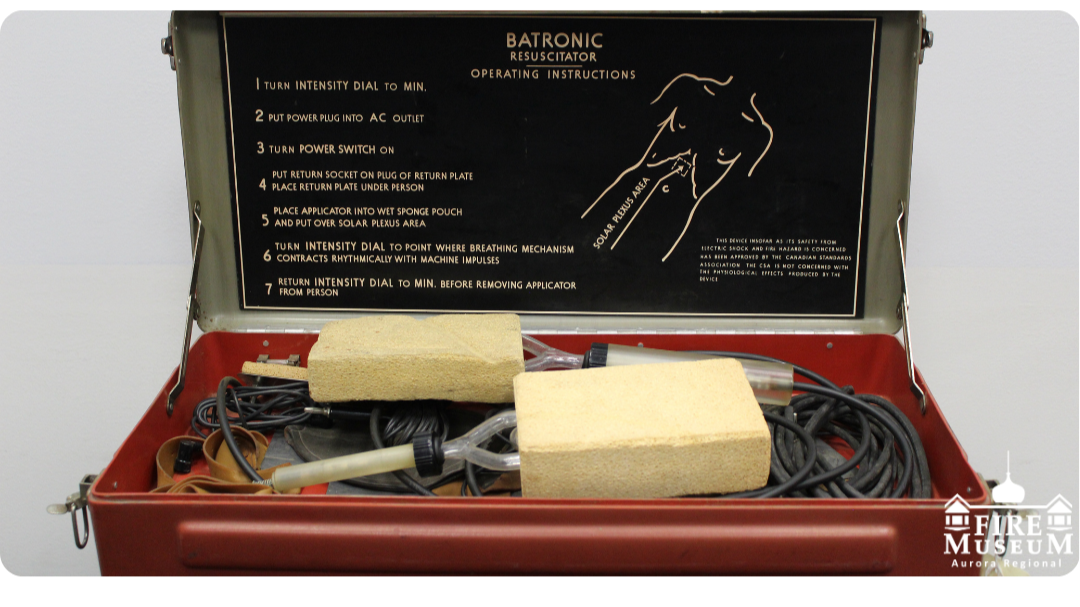
The type of resuscitator in our collection is a Batronic Resuscitator made by Batrow Laboratories, Inc.  “Batronic” is a term created by Batrow Labs referring to a current of electricity being used to stimulate a patient's diaphragm (a muscle surrounding the lungs) to regulate their breathing. This type of resuscitator, first created in 1951, uses a glass wand covered by a sponge that was dipped in water, a metal electrode placed on the patient's body, and a metal plate that is placed under the patient. The sponge covered wand is placed on a patient's abdomen to administer tiny electrical pulses that travel along nerves inside their body. The device was powered by a battery. These pulses “tingle but are painless.” Each pulse of electricity is only millionths of a second long but can go up to 60,000 volts with the amount of voltage being adjusted until the desired level of breathing is achieved. 

Batrow Laboratories Inc was founded around 1949 by John Anthony Batrow. John was passionate about medical devices- one of his first devices was used to stimulate nerves and muscles in polio patients. He dedicated a room in his home to treating patients, local doctors were impressed with him and sent some of their patients to him. John built a small laboratory next to his home to further develop new devices, this laboratory is where he created the Batronic resuscitator. He struggled for many years to get a patent on the Batronic due to the process in general being arduous but also because at the time he was looked down on by patent offices for not having any political connections. Batrow Labs started operating out of a larger facility in 1963. 

In 1970 the FDA deemed the Batronic to be ineffective and unsafe due to the risk of the patient getting heart damage as well as a lack of improvement with patients breathing. By that point in time, there were already safer, more effective, and less bulky types of resuscitators being used that made the Batronic resuscitator completely obsolete. The FDA went on to cease Batrow Labs from continuing to manufacture Batronic resuscitators as well as ban the use of them entirely. Those who owned a Batronic resuscitator were supposed to destroy them. 

This historical artifact’s existence serves as a cautionary tale of how even devices intended to help people can accidentally harm them if they are designed using faulty information. Medical knowledge is always being updated so it is not uncommon for something like this to occur. Learning from mistakes helps to preemptively avoid making similar mistakes again before it is too late.

Written and researched by Richard an Aurora University student interning at the Aurora Regional Fire Museum studying museum studies as a minor.

Thanks to the Branford Historical Society for sharing information about Batrow Lab Inc., which was located in Branford, including an oral history with members of the Batrow family and newspaper articles discussing the resuscitator.