From the Collection: The Strowger Telephone and the war against telephone operators!

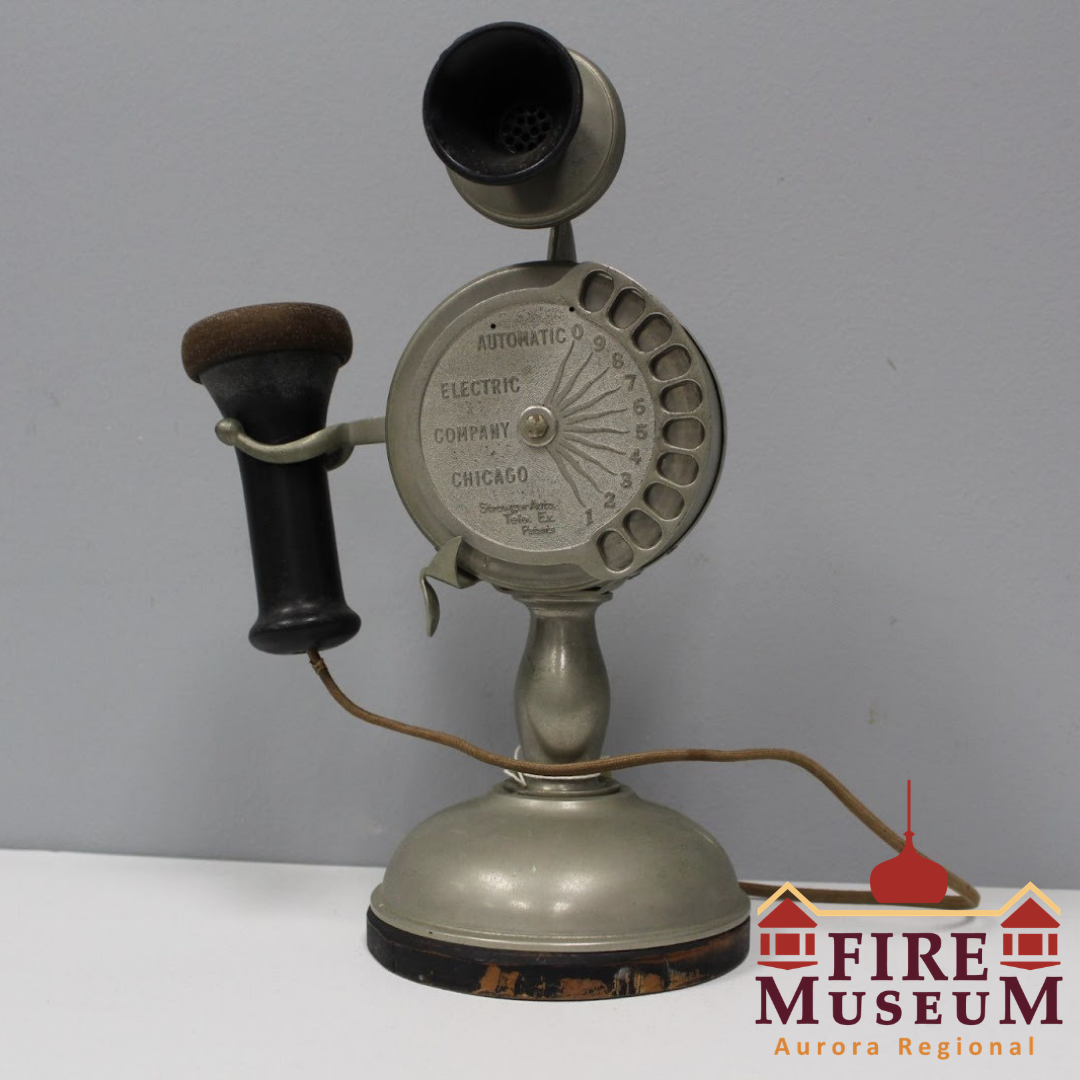
This artifact is a Strowger Potbelly Candlestick telephone, the first commercially available dial telephone. This particular example of Strowger's eleven-digit dial phone, dating back to 1905, revolutionized telecommunications. It did this by bypassing the need for telephone operators and allowing users to directly dial one another’s phone numbers. The speed of the rotary dial allowed for fast contact with fire and police services rather than utilizing the limited number of specialized fire alarm call boxes. Through a combination of innovative spirit and his conspiratorial resentment for switchboard operators Almon Strowger (1839-1902), an American inventor, developed the Strowger switch, a technology to bypass phone operators. Strowger was working as a funeral director, responsible for managing the funeral processes for the community of Kansas City, Missouri. Strowger had constant issues with his telephone. In addition to functionality problems, he believed that the local women working as switchboard operators were purposely misdirecting calls, sending them to his business competitors and causing him to lose a great deal of business. Strowger would often fly into long-winded rants about the switchboard operators, and would constantly call the phone company for repairs. 

A 1913 article from the Sioux City Journal interviewed Mr. Herman W. Ritterhoff, the superintendent of the Home Telephone company, and brief business associate of Stroweger. He was responsible for addressing Mr. Strowger's telephone complaints, frequently sending repair workers to his home. However, they never could find anything wrong with Mr. Strowger's phone, much to his fury. Mr. Herman Ritterhoff wrote about Strowger's switchboard obsession, saying, “he became possessed with the idea that the girl operators were systematically working against him, and that he was so convinced of this that he got to hate them. And his next idea was one of revenge against them”. Strowger's revenge, as it turned out, would come in the form of the Strowger Switch system. 


Strowger revealed his new innovation to Mr. Ritterhoff in 1888. Upon seeing Strowger's technical drawings, Ritterhoff realized that despite their amateur appearance, Strowger had outlined a transformative technology that could revolutionize communication and make both men very wealthy. Strowger had developed the technical specifications needed to make a working telephone that had no need for central switchboard call management. The Strowger Automatic Telephone Exchange Company was founded in 1891 by Strowger with his brother Alfred and nephew William. Ritterhoff assisted him to refine his plans and apply for a patent in 1891 due to Strowger's crude artistic abilities which were of no humor to Strowger, who was known to be quick to anger and held grudges for life.  Ritterhoff would later recount that Strowger's poor art skills and temper were responsible for Ritterhoff missing the chance of a lifetime after laughing at a crude prototype Strowger had built himself. Strowger stormed off in a rage and raised $50,000 in capital to start the Automatic Electric Company without Mr. Ritterhoff as a business partner. By 1892, the first phones utilizing the Stroweger switch were installed in La Porte, Indiana, by Stroweger for his personal use in his business. By the early 1910s, Stroweger switch phone systems made up 10% of all telephones in use, and were quickly becoming the standard automatic phone system in many cities. The system would also rapidly be adopted by fire and emergency services in the United States. Internationally, the British Post Office adopted the Stroweger system in 1912, with widespread adoption in wealthy metropolitan areas worldwide by the 1920s. 


 Ritterhoff eventually found  out the real cause of Mr. Strowger's phone troubles. Strowger had decided to bring his rusting old shop sign inside and had hung it on the wall over his telephone. Every time his front door opened and shut, wind would rush in, swinging the old sign back and forth. And on occasion, it would be caught perfectly in the two wall posts that rose above the telephone causing a short circuit. This meant that whenever the repairmen came to fix his phone, by simply opening the door, they fixed the problem. While Mr. Ritterhoff surely found this explanation entertaining, it did nothing to sway Strowger's insistence that it was the fault of the switchboard operators. 


Mr. Stowger continued his personal war against the switchboard operators, seeking to “put every last one of them out of a job”. Strowger Automatic Telephone Company had become Automatic Electric Company in 1901. By this point, Strowger had little involvement in the company, having sold his patent in 1896 and his shares in Automatic Electric in 1898. His patent sold for $1,800 (roughly $70,000 in 2026), and his shares sold for $10,000 (roughly $390,000 in 2026). Ritterhoff would later recount that Strowger's poor art skills and temper were responsible for Ritterhoff missing the chance of a lifetime after laughing at a crude prototype Strowger had built himself.

Ritterhoff had been promised 10,000 shares in the Automatic Electric Company, which by 1913 would have been worth millions. But upon traveling to Chicago to claim them, he learned Strowger had died and purposely left him out of his company. Prior to his death, Strowger would refuse to contact Ritterhoff for the rest of his life, even refusing to answer any letters sent by Ritterhoff. The Automatic Electric Company became greatly successful, financially dominating the telecommunication market into the 1940s, leaving Ritterhoff to comment in 1913: “That laugh cost me a million dollars”.


By Wyatt Harvell Aurora University Student

Aurora Regional Fire Museum Receives Two Statewide Honors from Illinois Association of Museums

Aurora, IL - The Aurora Regional Fire Museum was honored earlier this week with two prestigious statewide awards from the Illinois Association of Museums during its Annual Awards Ceremony. The museum received the 2026 Small Institution of the Year Award and the 2026 Award of Super Achievement (Exhibits), recognizing its overall impact in the region as well as inspiring curiosity in their youngest visitors. 

The 2026 Small Institution of the Year Award recognizes the museum’s leadership, innovation, and community impact. Through strategic direction and a strong commitment to mission-driven work, the organization has reached new heights under the guidance of its executive director, staff, and board. No longer solely a history museum, the Fire Museum has evolved into a regional destination—pairing historical interpretation with dynamic exhibitions, hands-on learning experiences, and impactful fire and life safety outreach.

“The Aurora Regional Fire Museum is an anchor in our city, and their ability to produce large-scale community impact with a small-institution footprint is nothing short of remarkable,” said Bobby Dobroski, owner of DobroSKILLS and a museum partner.

In addition to this top honor, the museum also received the 2026 Award of Super Achievement (Exhibits) for Safety at Play: A Firefighter’s Adventure. The fully reimagined hands-on exhibit, invites children to step into the role of a firefighter through immersive, imaginative play. Anchored by a child-sized fire station and fire engine, the exhibit allows children to experience daily life in the firehouse - cooking meals, putting on gear, driving a fire engine, and safely “putting out” play fires.  Since opening November 2025, Safety at Play has quickly become a standout exhibition, engaging families and reinforcing critical fire safety lessons through interactive learning, helping inspire the next generation of firefighters. 

“These awards reflect the exceptional work of our staff, whose dedication and creativity bring the museum’s mission to life every day. As a board, we are proud to support a team that continues to elevate the museum’s impact across our community and region,” said Board President Karen Yaggie.

“These awards energize our vision for the future—continuing to evolve, share regional stories, inspire curiosity, and lead in fire safety education,” said Executive Director Brian Failing.

The Aurora Regional Fire Museum preserves the legacy of the fire service by showcasing its regional collections and exhibits while teaching fire safety and prevention. From humble beginnings to the vibrant

institution it is today, the museum remains dedicated to honoring the past, present, and future of the fire service. The Illinois Association of Museums (IAM) is a nonprofit organization dedicated to supporting and strengthening museums and cultural institutions throughout Illinois. Through advocacy, professional development, and community building, IAM advances the role of museums as vital contributors to education, economic development, and quality of life. 

###

For more information about this recognition or how to become involved in the museum, contact Brian Failing, Executive Director, at 630-256-4140 or info@auroraregionalfiremuseum.org.

From the Collection-Telegraph

The bits of metal seen before you is actually a telegraph, though it may not seem like much but it was certainly helpful during the 19th century. The first aspect of the telegraph was made by a Frenchman called Claude Chappe. In the year of 1794, he was able to successfully create an optical telegraph that relayed a message over 9 miles. Europeans continued to advance this new technology until it reached the United States. The optical telegraph then began to lose its popularity when electrical telegraph began to be widely used. The difference between the two is that an optical uses towers with arms or boards on top to create words visually by moving the arms to communicate with the other towers while an electric uses a magnetic field to make the needle move left or right. Which was a much cheaper and stable option at the time. 

An American painter and inventor known as Samuel F.B. Morse began to fiddle around with the telegraph to relay messages for farther distances. He was then able to create a device that would be able to make a series of electrical pulses which would then be translated into words by the person receiving the message. Once this method was implemented by the government, states were now able to communicate with one another faster than ever before. The telegraph was then placed at official government buildings such as newspaper offices, police stations, and fire stations. The fire stations placed numerical alarm boxes with telegraph keys connected via a telegraph cable; One box is kept in the central alarm station, and the others are placed somewhere easily accessible out in the neighborhood. 

Reporting an emergency with the fire alarm telegraph was a multi-step process. First, the central alarm office receives the call from the fire alarm box from which it is pulled. The alarm office would know where the call was coming from based on the number of the fire alarm box that would be punched out of the piece of paper tape. Then, the dispatcher would send out the alarm and box number to the closest firehouse. Eventually, technology advanced and the telegraph became less popular once the telephone was introduced in the late 1800’s. 

In Aurora, the city finally authorized the construction of the fire alarm telegraph on December 18, 1878. By January 22, 1879 the connections of the fire alarm box were completed. One was located in the Broadway stairway of the Aurora National Bank block, and the other on River street. Unfortunately, in between the construction of the fire alarm boxes, a man by the name of Thomas Bexon fell to his death on the 15th of January in 1879 when he was fastening wire to the last pole.

By the 1920's the rotary dial telephone became the most efficient way to communicate especially in times of urgency. This eventually led to the fall of the telegraph. The last telegram message was sent in the year of 2006 on January 26th to the office of Tom Wolfe in Manhattan.

By Paola Hurtado, Waubonsee Community College Student

From the Collection-Batronic Resuscitator by Batrow Labs Inc.

A resuscitator is a device that inflates air into a patient's lungs to assist with breathing. Firefighters usually use resuscitators if a victim has inhaled smoke from a fire and needs their lungs restored with air. Firefighters and EMT's must be properly trained to use a resuscitator because using it incorrectly can injure the patient. The first resuscitator was created in 1907.

The type of resuscitator in our collection is a Batronic Resuscitator made by Batrow Laboratories, Inc.  “Batronic” is a term created by Batrow Labs referring to a current of electricity being used to stimulate a patient's diaphragm (a muscle surrounding the lungs) to regulate their breathing. This type of resuscitator, first created in 1951, uses a glass wand covered by a sponge that was dipped in water, a metal electrode placed on the patient's body, and a metal plate that is placed under the patient. The sponge covered wand is placed on a patient's abdomen to administer tiny electrical pulses that travel along nerves inside their body. The device was powered by a battery. These pulses “tingle but are painless.” Each pulse of electricity is only millionths of a second long but can go up to 60,000 volts with the amount of voltage being adjusted until the desired level of breathing is achieved. 

Batrow Laboratories Inc was founded around 1949 by John Anthony Batrow. John was passionate about medical devices- one of his first devices was used to stimulate nerves and muscles in polio patients. He dedicated a room in his home to treating patients, local doctors were impressed with him and sent some of their patients to him. John built a small laboratory next to his home to further develop new devices, this laboratory is where he created the Batronic resuscitator. He struggled for many years to get a patent on the Batronic due to the process in general being arduous but also because at the time he was looked down on by patent offices for not having any political connections. Batrow Labs started operating out of a larger facility in 1963. 

In 1970 the FDA deemed the Batronic to be ineffective and unsafe due to the risk of the patient getting heart damage as well as a lack of improvement with patients breathing. By that point in time, there were already safer, more effective, and less bulky types of resuscitators being used that made the Batronic resuscitator completely obsolete. The FDA went on to cease Batrow Labs from continuing to manufacture Batronic resuscitators as well as ban the use of them entirely. Those who owned a Batronic resuscitator were supposed to destroy them. 

This historical artifact’s existence serves as a cautionary tale of how even devices intended to help people can accidentally harm them if they are designed using faulty information. Medical knowledge is always being updated so it is not uncommon for something like this to occur. Learning from mistakes helps to preemptively avoid making similar mistakes again before it is too late.

Written and researched by Richard an Aurora University student interning at the Aurora Regional Fire Museum studying museum studies as a minor.

Thanks to the Branford Historical Society for sharing information about Batrow Lab Inc., which was located in Branford, including an oral history with members of the Batrow family and newspaper articles discussing the resuscitator.

2025 Fire Museum Holiday Ornament Pre-Order

Our ornament this year is a 1948 American LaFrance 700 series pumper!


This popular model was purchased by both the City of Aurora and the City of Batavia. This engine had the latest firefighting technology and it was said that you could balance a coin on the hood while the engine was running, the motor was that smooth!

These two engines crossed paths during a devastating fire. On March 26, 1967, the vacant Cotton Mill on North River St. in Downtown Aurora caught on fire. The building scheduled for demolition had its sprinkler system shut off so the fire spread quickly. While Aurora Fire Department worked to quell the Cotton Mill fire with their 1948 American LaFrance the Batavia Fire Department sent their own 1948 American LaFrance to work out of Central Station to respond to any other calls the department received.

Unfortunately, Aurora’s 1948 American LaFrance 700 series pumper was destroyed in the Cotton Mill fire. Assistant Chief Norm Buhrmann, when interviewed about the fire, explained that “the number three truck was attached to a hydrant when the heat became very intense…a set of high tension wires fell on the vehicle.”

To honor these two pumpers that both worked to protect the city of Aurora during a devastating fire, our 2025 Holiday Ornament showcases one town on each side of the ornament. 

Pre-order your ornament today at: https://bit.ly/2025ARFMHolidayOrnament

Ornaments are $20 or 2 for $35. They will be available for pickup or delivery and are expected to arrive around Thanksgiving.


Aurora Regional Fire Museum Receives Corporate Responsibility Award

Aurora Regional Fire Museum Receives Corporate Responsibility Award

During Fire Prevention Week, the Aurora Regional Fire Museum was recognized with the Corporate Responsibility Award at the 84th Annual Fire Prevention Week Luncheon, presented by Camp I Am Me by the Illinois Fire Safety Alliance. The luncheon, held on Thursday, October 9 in Woodridge, brought together fire service professionals and community partners from across the state to honor individuals and organizations making significant contributions to fire safety and burn prevention.