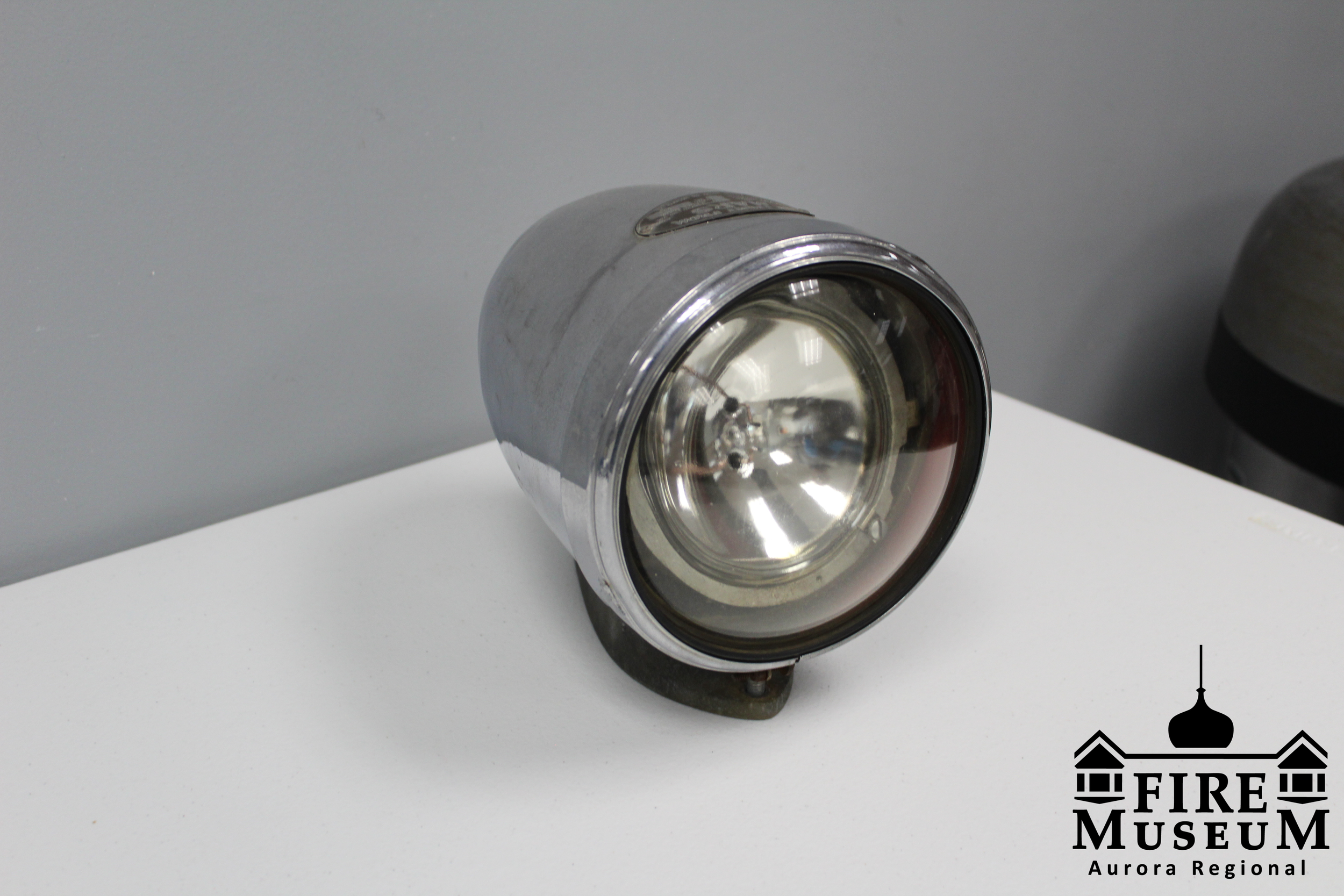
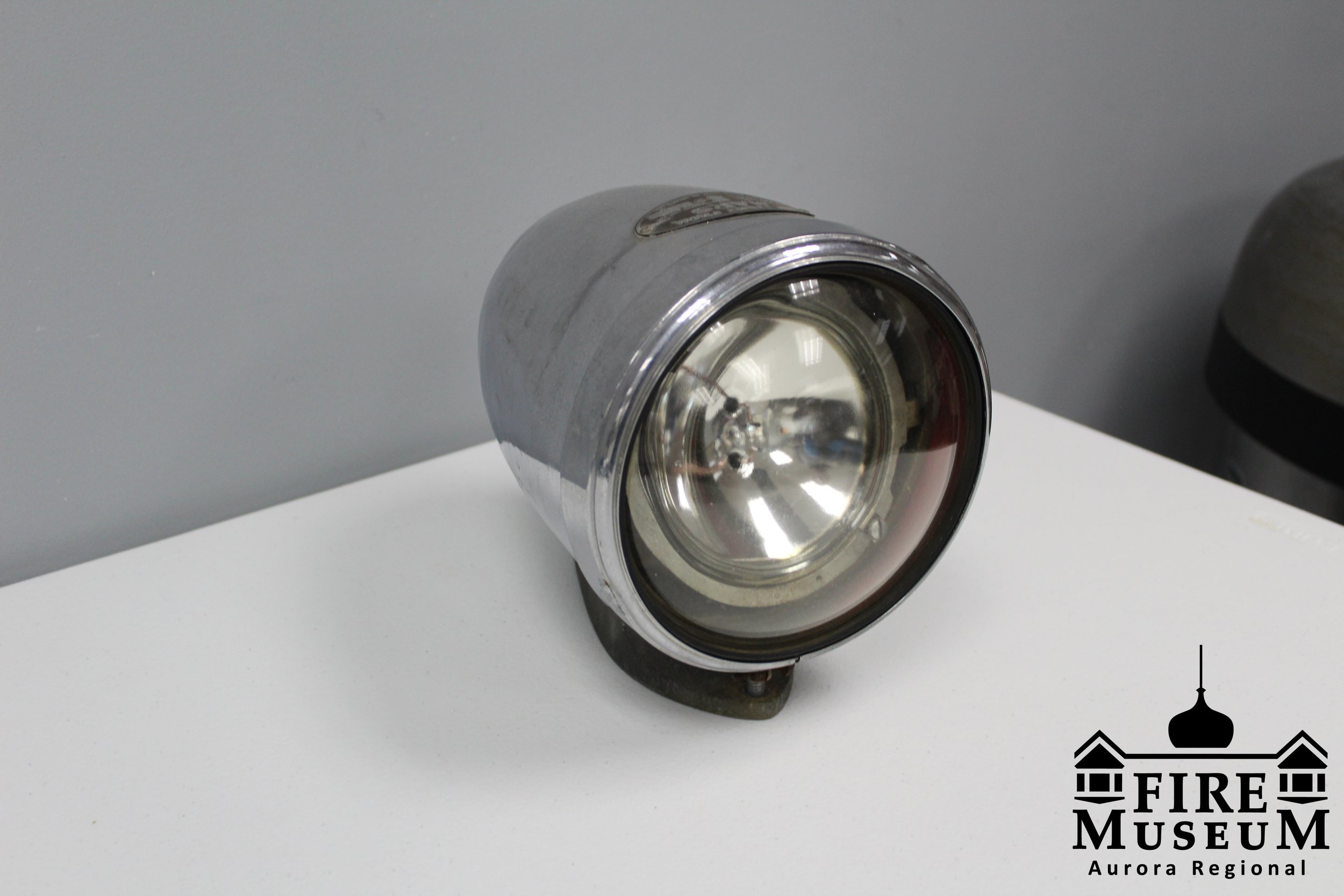
This artifact is a 1936 Mars Signal light, a safety light used in firefighting and railroad operations. The light utilizes an oscillating mechanism to move the direction of the light both vertically and horizontally, greatly improving visibility. This benefits both drivers and pedestrians and has become an instrumental tool for emergency services. Jerry Kennelly, a firefighter in Chicago, created the light to prevent accidents, navigate heavy traffic during emergencies, and clearly distinguish emergency vehicles. Kennelly began developing safety lights in 1925, with early versions being applied to fire trucks as early as 1929. Kennelly would continue to refine his signal light technology during the 1930s, with multiple designs being patented in both the United States and Canada including the 1936 model. The Chicago Fire Department was an early adopter of the signal light, beginning to incorporate it into its fire trucks as early as 1929 and expanding its use throughout the 1930s as production increased. During the late 1930s and into the early 1940s, the use of Mars Lights had expanded to other U.S. Fire Departments, including New York.
The Mars Light was first adopted by the Aurora Fire Department for use on the 1934 Pirsch firetruck, and then on the 1942 American LaFrance pumper. New firetrucks were met with much fanfare in Aurora, the Beacon News noted in 1942: “The screaming siren, one of the new, more powerful models, and a swinging “mars” light cleared traffic as people stared at the new fire truck.” The impact of Mars Lights in firefighting was most noticeable in densely populated urban areas, where they greatly reduced collision risks in emergencies. This was particularly useful in Aurora, where the fire department faced persistent traffic issues when going to fires Mars Lights continue to be used by many fire departments worldwide, though the adoption of LED standards has led to a decline in the use of original-style Mars Lights. LED Mars Lights are capable of the same movement non-mechanically, in addition to being roughly 3 times brighter than the original designs.
The Mars Light, also referred to as “The Light From Mars”, was heavily utilized by both fire departments and the railroads; however, due to the mechanical complexity of the device, maintenance costs were particularly high. This led railroads to move away from Mars Lights in favor of newer and cheaper signal lights. In addition to logistical considerations, federal laws adopted on December 31st, 1997, required the retirement of Mars Lights in favor of a standardized series of “ditch lights.” Ditch lights are low and fixed-position lights, which were discovered to be more effective at allowing motorists to gauge the speed and distance of a train. The law dictated that auxiliary lights on trains must be functional, meaning if a Mars Light experienced a mechanical failure, the locomotive was non-compliant, and railroads would face fines. This led to all trains in the United States, with the exception of museum pieces, to move away from Mars Lights before the year 2000. However, in firefighting, the Mars Light is still utilized widely for several practical reasons. Unlike locomotives, the oscillating light mechanism is necessary for firefighters’ visibility, and changing to a fixed beam light would decrease visibility in fires. The oscillating effect is also beneficial to firetruck drivers as it makes objects and pedestrians stand out more to the driver. While the traditional style of Mars Lights is still produced, some fire departments have adopted new LED versions to reduce maintenance issues and improve energy efficiency.
By Wyatt Harvell, Aurora University Student.