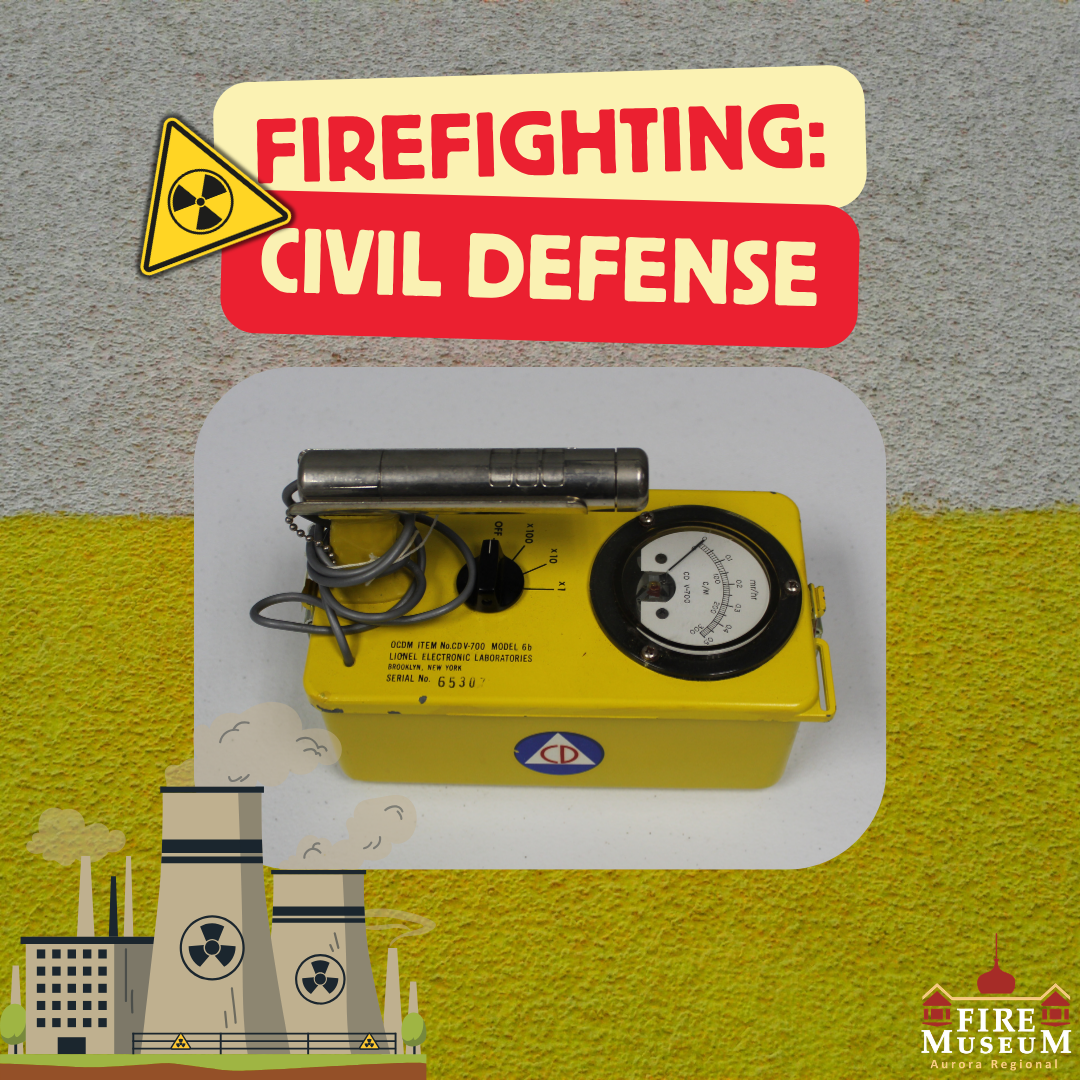
This artifact is an example of the CDV-700 model Civil Defense Radiation Meter, otherwise known as a Geiger counter. The Geiger counter, named for its inventor, Hans Geiger, was first developed in 1928 based on technology Hans worked with at the University of Manchester starting in 1908. Geiger counters have a wide range of applications such as: environmental monitoring, industrial workplace safety, emergency response services, the collection of scientific data, and for hobbyists. In firefighting, the use of Geiger counters is not common, but many departments maintain and train with these systems in the event of a nuclear disaster or attack. The Aurora Fire Department has trained with and maintained Geiger counters and personal protective gear needed in the case of fallout response since the late 1950s. Firefighters need to monitor radiation levels when responding to these most critical situations, such as a major failure at a nuclear plant. Having constant monitoring of radiation exposure enables firefighters to coordinate firefighting operations while limiting their exposure. Geiger counters are especially common fire departments in major cities to prepare for potential nuclear attacks, as was commonly feared during the cold war. Geiger counters such as the CDV-700 model were explicitly designed with widespread civil defense use in mind, rather than strictly scientific purposes. Cities throughout the United States, beginning in the 1950s, received civil defense funding to furnish air raid systems and proper training for emergency response personnel.
The Aurora Fire Department began to utilize Geiger counters and train firemen in radiological response during the 1950s. Civil defense drills were brought back to emergency preparedness during the Cold War in Aurora. Bombing drills had been carried out beginning Friday, July 31st, 1942, after the U.S. entry into WW2 the previous winter. These included blackout drills and simulated enemy incendiary attacks, training professional and volunteer firemen on how to respond quickly and effectively. These rapid response drills focused on how to respond to enemy bombings and were also carried out in 1951 during the Korean War. By the end of the decade, threats had shifted from incendiary bombings or sabotage to fallout preparedness and response drills. The Aurora Fire Department began training firefighters at radioactive fallout schools in Aurora beginning in 1959. Each training class completed would result in more radiological kits for the Aurora Fire Department, as the Civil Defense director commented on Wednesday, January 7th, 1959: “Aurora has been promised 2 radiological kits valued at $2,000.00 for organizing the first class, and another kit for each class of 20 students thereafter.” The fire department completed enough training to furnish all fire stations in Aurora with radiological kits. While the A.F.D. has not needed to utilize said radiological kits in responding to emergencies, having them on hand contributed to Aurora’s status as having one of the most modern and well-equipped fire departments in the state.
By Wyatt Harvell, Aurora University Student